
About
Weegee — born Usher Fellig in Złoczów, Austrian Galicia, in 1899 and renamed Arthur after his family emigrated to New York in 1909 — became the archetype of the freelance American press photographer. After years as a darkroom technician at Acme Newspictures, he left in 1935 to work independently, monitoring police radio and racing to crime scenes, fires and accidents across Manhattan, often arriving before the police themselves. This uncanny timing earned him the nickname "Weegee," a phonetic play on the Ouija board.
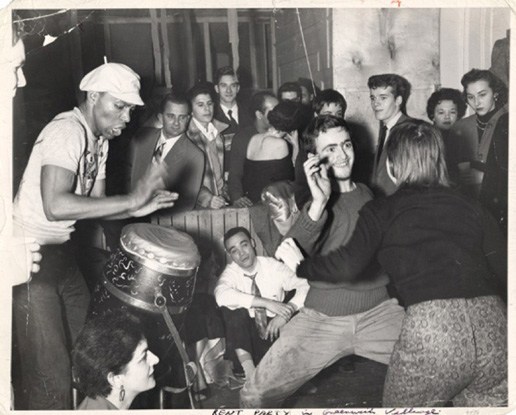
Working at night with a 4x5 Speed Graphic camera, flashbulbs and a fixed focus distance, Weegee produced a body of work of unflinching, high-contrast immediacy: murder victims under sheets, tenement fires, drunks, lovers and the well-heeled caught off guard on Park Avenue. His pictures were sold to the tabloids and to Life magazine, and collected in the 1945 book Naked City, which cemented his reputation as chronicler of the city's underside and gave photojournalism a new, tabloid-inflected visual vocabulary.
In the later 1940s and 1950s Weegee moved toward more experimental territory, producing distorted portraits, caricatures and photomontages using trick lenses, and working in Hollywood as an actor, consultant and photographer, including an association with Stanley Kubrick on Dr. Strangelove. He also traveled extensively in Europe in the 1960s. He died in New York in 1968.
Weegee's photographs are held in major public collections including the International Center of Photography, which holds his archive, and the Museum of Modern Art, New York, and remain foundational reference points for the history of street and crime photography.
Exhibitions
Solo
- 2020
Scenes in the City — Galerie Julian Sander, Cologne
Group
- 2025
AIPAD 2025 — Galerie Julian Sander
- 2020
Brocante: La Maison de Chineur — Images and Objects from the Gerd Sander Collection — Galerie Julian Sander, Cologne
Links
Biographical information based on galeriejuliansander.de and public sources.
Collections
International Center of Photography, New York · Museum of Modern Art, New York